
The integration of 5G (the fifth – generation mobile communication technology) and AIoT (Artificial Intelligence + Internet of Things) is more than a simple combination of technologies. It serves as an “infrastructure – level” enabler for AIoT, addressing core challenges such as connection scale, data transmission, real – time response, and scenario adaptation. This integration drives AIoT from “fragmented perception” to “large – scale intelligence”. Leveraging its three key features—eMBB (Enhanced Mobile Broadband), uRLLC (Ultra – Reliable Low – Latency Communications), and mMTC (Massive Machine – Type Communications)—5G provides end – to – end support for AIoT implementation across the connection and application layers.
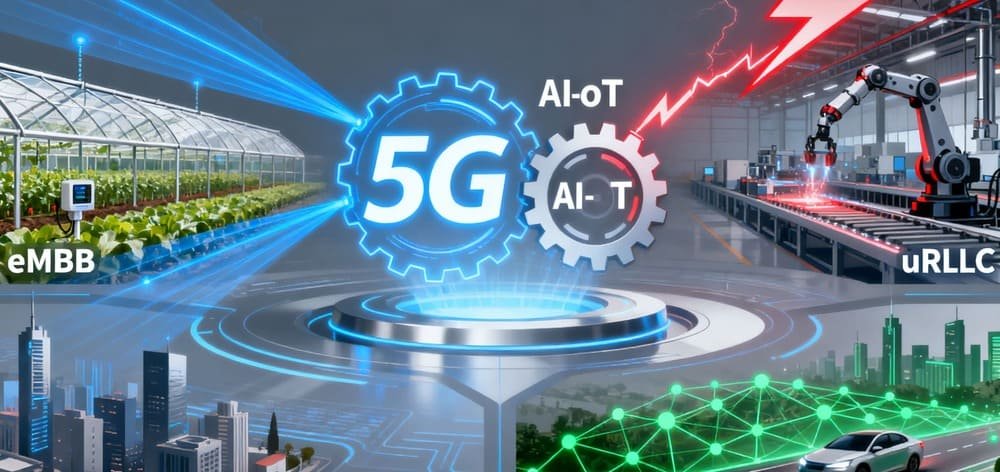
First and foremost, 5G breaks through connection bottlenecks to support the large – scale access of massive AIoT devices. The essence of AIoT lies in “connecting everything”, yet traditional 4G networks have a clear limitation in the number of connected devices (about 100,000 per square kilometer), which is insufficient for scenarios like smart cities, smart agriculture, and industrial IoT that require “millions of devices online simultaneously”. The mMTC feature of 5G increases the number of connected devices per square kilometer to over 1 million. It also supports the hybrid access of low – power, low – cost narrow – band IoT devices (such as NB – IoT and LoRa) and high – speed devices. In smart agriculture, for example, a 10,000 – mu farm can connect thousands of soil moisture sensors, weather monitoring devices, and UAV navigation modules at the same time. These devices transmit data to the AI platform in real time, enabling precise irrigation and pest early warning. In smart cities, millions of smart electricity meters, water meters, traffic cameras, and environmental monitoring terminals can be deployed. Through 5G connection, they form the “neural endings of the city”, supporting the dynamic optimization of traffic flow and energy consumption by AI.
Secondly, 5G accelerates data transmission, solving the pain point of “real – time transmission of massive AIoT data”. The “intelligence” of AIoT relies on “data feeding”. A large amount of data generated by terminal devices (sensors, cameras, industrial machine tools), such as 4K/8K videos and high – frequency sensor data, needs to be transmitted to edge nodes or cloud AI platforms for analysis and processing. The insufficient bandwidth of traditional networks (with a 4G peak rate of about 1 Gbps) often leads to data transmission delays, freezes, and even inability to support high – bandwidth scenarios. The eMBB feature of 5G raises the peak rate to 10 – 20 Gbps (with an actual experience rate of 1 – 5 Gbps) and significantly improves the stability of the downlink rate for a single user, providing a high – speed channel for the “data flood” of AIoT. In smart security, 4K/8K high – definition cameras on urban roads can transmit video streams to the AI center in real time via 5G, enabling “second – level face recognition and abnormal behavior detection” (such as running red lights and high – rise parabolic objects) and avoiding video freezes and analysis delays caused by insufficient bandwidth. In industrial visual quality inspection, high – speed industrial cameras on factory assembly lines need to take dozens of high – definition images per second. Through real – time transmission to the AI quality inspection system via 5G, “defect identification” can be completed within 100 ms, which is much faster than the second – level delay of traditional networks.
Thirdly, 5G reduces latency and improves reliability, ensuring the implementation of “high – real – time AIoT scenarios”. Some AIoT scenarios, such as industrial control, autonomous driving, and telemedicine, have extremely high requirements for “latency” and “reliability”. Once data transmission is delayed or lost, it may lead to equipment failures and safety accidents. The end – to – end latency of traditional 4G networks is about 50 – 100 ms, and the reliability is about 99.9%, which cannot meet such needs. The uRLLC feature of 5G reduces the end – to – end latency to less than 1 ms and improves the reliability to 99.999% (i.e., “five nines”, with annual downtime of no more than 5 minutes), providing a key guarantee for the “real – time intelligent decision – making” of AIoT. In industrial AI control, robotic arms and AGV robots in factories need to adjust their actions in real time through AI algorithms. The low latency of 5G ensures that “AI decision – making instructions” are transmitted to the equipment within 1 ms, avoiding production accidents caused by robotic arm freezes. In autonomous driving (vehicle – to – infrastructure collaboration), autonomous vehicles need to interact with road side units (RSUs) and other vehicles in real time to obtain road condition data via AIoT. The 1 ms latency and high reliability of 5G ensure that instructions such as “collision warning” and “lane collaboration” take effect immediately, avoiding car accidents caused by delays. In remote AI – assisted surgery, doctors remotely control surgical robots through AI – assisted systems. The low latency of 5G ensures that “hand movements” are completely synchronized with “robot operations” (latency < 1 ms), and high reliability avoids surgical risks caused by signal loss.
In conclusion, 5G is the “infrastructure foundation” of AIoT. If AIoT is the “neural network of a smart society”, then 5G is the “highway, power grid, and communication hub” that supports this network. It solves the “scale problem of connecting everything” through massive connections, the “efficiency problem of data transmission” through high – speed bandwidth, and the “safety problem of real – time decision – making” through low latency and high reliability. Ultimately, 5G enables AIoT to move from “laboratory technology” to “large – scale commercial application”, empowering the intelligent transformation of various industries such as industry, transportation, medical care, and cities.