
Unmanned Aerial Vehicles (UAVs) rely on diverse communication technologies to transmit data, control signals, and achieve flight missions, while 5G has become a transformative force that addresses key limitations of traditional UAV communication.
1. Mainstream UAV Communication Methods
UAV communication primarily focuses on two core data types: control signals (for flight command and status feedback) and payload data (such as high-definition video or sensor data). The following are the most widely used communication methods:
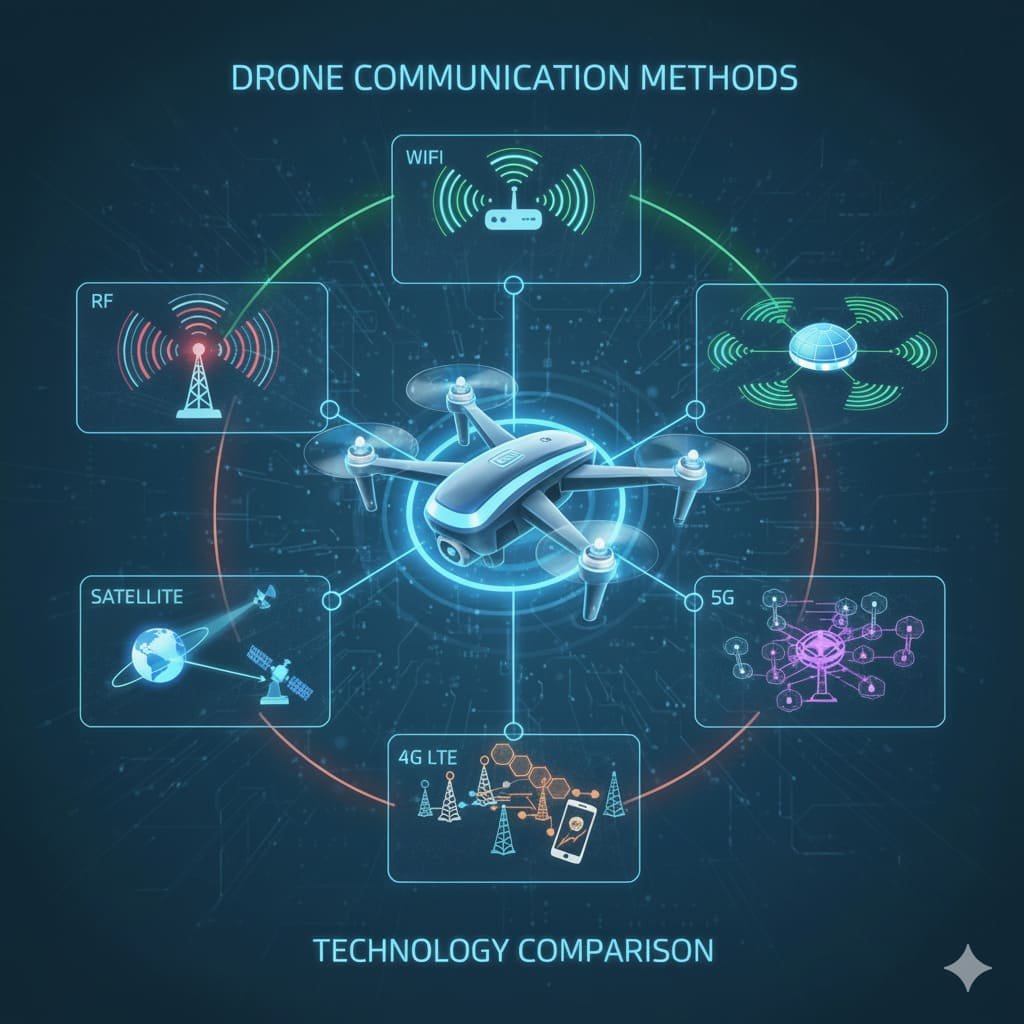
Communication Method | Frequency Band | Key Advantages | Critical Limitations | Typical Application Scenarios |
Radio Frequency (RF) | 433 MHz, 2.4 GHz, 5.8 GHz | Low cost; simple deployment; strong anti-interference in short distances | Short communication range (usually <10 km); limited bandwidth (cannot transmit high-definition video stably) | Consumer-grade UAVs (e.g., aerial photography drones for hobbies); short-range inspection (e.g., small-area power line checks) |
Wi-Fi (IEEE 802.11) | 2.4 GHz, 5 GHz | High bandwidth (supports 4K video transmission); compatible with most ground devices | Very short range (<5 km); poor penetration (easily blocked by buildings/trees); unstable in complex environments | Close-range professional tasks (e.g., indoor mapping, near-building inspection) |
Satellite Communication | L-band, Ku-band, Ka-band | Global coverage (no geographical restrictions); stable for long-distance transmission | High cost (satellite modules and subscription fees); high latency (0.5–2 seconds); limited bandwidth | Long-endurance UAVs (e.g., ocean patrol, polar scientific research); UAVs operating in remote areas (no ground network coverage) |
4G LTE | 700 MHz–2.6 GHz | Longer range than RF/Wi-Fi; stable bandwidth (supports 1080P video); wide ground network coverage | High latency (20–50 ms); cannot support ultra-dense UAV swarms; limited by ground base station coverage | Medium-range commercial UAVs (e.g., urban logistics, large-area agricultural spraying) |
2. The Impact of 5G on UAV Communication
5G, with its technical advantages of high bandwidth, low latency, and massive connectivity, directly addresses the pain points of traditional UAV communication and expands UAV application boundaries. Its key impacts are reflected in three aspects:
2.1 Breaking Bandwidth Limitations
Traditional methods like RF and Wi-Fi struggle to transmit high-volume data (e.g., 8K video, multi-sensor 3D data). 5G’s peak bandwidth (up to 10 Gbps) enables UAVs to transmit ultra-high-definition video and real-time sensor data simultaneously, which is critical for scenarios like precision medical rescue (transmitting patient status in real time) and high-precision mapping.
2.2 Reducing Latency for Safety & Precision
High latency (e.g., 20–50 ms in 4G, >500 ms in satellite communication) increases the risk of UAV collisions or mission failures. 5G’s ultra-low latency (1–5 ms) allows near-real-time control of UAVs, making it feasible for high-risk, high-precision tasks such as autonomous aerial refueling, drone-based power grid fault repair, and urban air mobility (UAM) for passenger transport.
2.3 Supporting Massive UAV Swarms
Traditional communication methods can only connect dozens of UAVs at once due to limited connectivity. 5G’s massive machine-type communication (mMTC) technology supports up to 1 million devices per square kilometer, enabling large-scale UAV swarms for applications like synchronized aerial performances, large-area disaster rescue (coordinated search), and military reconnaissance.
3. Comparison: 5G vs. Traditional UAV Communication
The table below clearly shows 5G’s advantages over traditional communication methods in core performance indicators:
Performance Indicator | 5G | RF | Wi-Fi | Satellite | 4G LTE |
Communication Range | Dependent on base stations (usually 10–50 km) | <10 km | <5 km | Global | 5–30 km |
Latency | 1–5 ms | 10–20 ms | 20–30 ms | 500–2000 ms | 20–50 ms |
Peak Bandwidth | Up to 10 Gbps | <10 Mbps | <1 Gbps | <100 Mbps | <100 Mbps |
Connectivity Density | Up to 1 million/km² | <100/km² | <500/km² | <1000/km² | <10,000/km² |
Cost | Medium (higher than RF/Wi-Fi, lower than satellite) | Low | Low | Very High | Medium |
4. How to Choose a Communication Method
Your choice should be guided by your specific needs:
Personal Entertainment & Aerial Photography: Drones using traditional radio control are sufficient, offering a low-cost and high-performance experience.
Commercial Applications & BVLOS Operations: It is essential to choose models that support 4G/5G cellular networks to overcome range limitations and operate in complex environments.
Future Outlook: The trend is moving towards multi-link integration, where drones can intelligently switch between radio, 5G, and satellite communication based on the environment to maintain an optimal connection.
As a company focusing on wireless communications for 15 years, we have offered WIFI and 5G board to the UAV manufacturers. If you have interest, please feel free to contact with us.