
1. Test Purpose
This test aims to verify the operational stability, performance, and hardware reliability of the target 5G router under extreme high and low temperature environments. By simulating extreme usage scenarios of -45℃ (low temperature) and 85℃ (high temperature), the core functions (5G signal reception and transmission, network connection stability, data transmission rate), hardware components (motherboard, antenna, power module), and overall operating status of the router are evaluated to determine whether they meet the design specifications and practical application requirements. This provides data support for the outdoor deployment and use of the product in harsh environments.
2. Test Equipment and Environment
2.1 Test Equipment
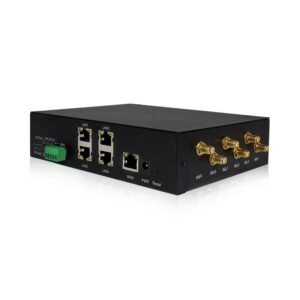
- Test Samples: Target 5G routers (Model: R5100, Hardware Version: V2.0, Firmware Version: V2185), Quantity: 6 units (Numbered A, B, C, D, E, F);
- Auxiliary Equipment: High and Low Temperature Test Chamber (Model: TH-80, Temperature Range: -70℃~150℃, Temperature Control Accuracy: ±0.5℃);
- Test Tools: Network Performance Tester (Model: IXIA 100G), 5G Signal Strength Tester (Model: Anritsu MT8000A), Power Consumption Tester (Model: Chroma 66200), Multimeter, Laptop (Installed with Speedtest (network speed testing software) and Ping testing tool);
- Supporting Equipment: Stable 5G Signal Source (Signal Strength: -70dBm, Frequency Band: Sub-6GHz), Power Adapter (Specification: 12V/2A, Matching the Router).
2.2 Test Environment
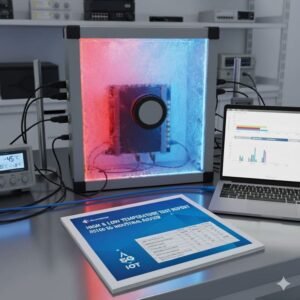
- Low Temperature Test Environment: The temperature inside the high and low temperature test chamber is stabilized at -45℃, the humidity is controlled at 45%±5% RH, and there are no external interference sources;
- High Temperature Test Environment: The temperature inside the high and low temperature test chamber is stabilized at 85℃, the humidity is controlled at 30%±5% RH, and there are no external interference sources;
- Reference Environment (for comparison): Room temperature 25℃, humidity 50%±5% RH, no external interference sources.
3. Test Items and Procedures
3.1 Test Items
- Appearance Inspection: Observe whether the router has physical damages such as shell deformation, cracking, and interface looseness under high and low temperature environments;
- Power-on Startup Test: Verify whether the router can start normally under extreme temperatures and whether the startup time is within a reasonable range (≤60 seconds);
- 5G Signal Connection Test: Test the connection stability between the router and the 5G signal source, and record the signal strength and signal-to-noise ratio;
- Data Transmission Performance Test: Test the download rate, upload rate, ping value (delay), and packet loss rate through wired (Gigabit Ethernet port) and wireless (Wi-Fi 6) methods;
- Long-term Operation Stability Test: Continuously operate under extreme temperatures for 24 hours, and record the operating status, signal parameters, and transmission performance every 1 hour;
- Power Consumption Test: Record the power consumption of the router in standby and full-load transmission states;
- Temperature Recovery Test: Place the router that has undergone high and low temperature tests in a room temperature environment, and test whether various performances return to normal after 30 minutes of recovery.
3.2 Test Procedures
- Reference Test: Conduct all the above test items on the 6 routers in a room temperature environment, and record the reference data as a basis for comparison;
- Low Temperature Test:
(1) Place Routers A, B, and C into the high and low temperature test chamber, set the temperature to -45℃, and maintain a constant temperature for 2 hours;
(2) Connect the power supply, 5G signal source, and test equipment in the test chamber, and perform the power-on startup test;
(3) After successful startup, conduct the signal connection test and data transmission performance test in sequence, and record the data;
(4) Maintain the -45℃ environment, continue operation for 24 hours, and record the operating status and performance data every 1 hour;
(5) After the test is completed, turn off the power, take the routers out and place them at room temperature, and conduct appearance inspection and performance retest after 30 minutes of recovery;
- High Temperature Test:
(1) Place Routers D, E, and F into the high and low temperature test chamber, set the temperature to 85℃, and maintain a constant temperature for 2 hours;
(2) Repeat steps (2)-(5) in the low temperature test to complete all test items under high temperature environment;
- Data Collation: Compare the reference data, low temperature test data, and high temperature test data to analyze the performance changes of the router under extreme temperatures.
Low Temperature Test 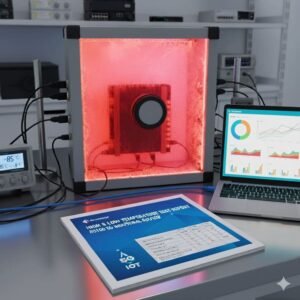
High Temperature Test
4. Test Results
4.1 Appearance Inspection Results
Test Environment | Router Number | Shell Status | Interface Status | Other Physical Damages |
Room Temperature Reference | A, B, C, D, E, F | No deformation, no cracking | Firm interface | None |
-45℃ Low Temperature | A, B, C | No deformation, no cracking | Firm interface | None |
85℃ High Temperature | D, E, F | No deformation, no cracking | Firm interface | None |
After Recovery | A, B, C, D, E, F | No deformation, no cracking | Firm interface | None |
4.2 Power-on Startup Test Results
Test Environment | Router Number | Can Start Normally | Startup Time (seconds) | Reference Startup Time (seconds) |
-45℃ Low Temperature | A | Yes | 45 | 32 |
-45℃ Low Temperature | B | Yes | 43 | 32 |
-45℃ Low Temperature | C | Yes | 44 | 32 |
85℃ High Temperature | D | Yes | 38 | 32 |
85℃ High Temperature | E | Yes | 37 | 32 |
85℃ High Temperature | F | Yes | 39 | 32 |
After Recovery | A | Yes | 33 | 32 |
After Recovery | B | Yes | 32 | 32 |
After Recovery | C | Yes | 31 | 32 |
After Recovery | D | Yes | 32 | 32 |
After Recovery | E | Yes | 31 | 32 |
After Recovery | F | Yes | 33 | 32 |
4.3 5G Signal Connection Test Results
Test Environment | Router Number | Signal Strength (dBm) | Signal-to-Noise Ratio (dB) | Reference Signal Strength (dBm) | Reference Signal-to-Noise Ratio (dB) | Connection Stability |
-45℃ Low Temperature | A | -63 | 18 | -60 | 22 | Stable, no disconnection |
-45℃ Low Temperature | B | -62 | 19 | -60 | 22 | Stable, no disconnection |
-45℃ Low Temperature | C | -64 | 17 | -60 | 22 | Stable, no disconnection |
85℃ High Temperature | D | -65 | 16 | -60 | 22 | Stable, no disconnection |
85℃ High Temperature | E | -64 | 17 | -60 | 22 | Stable, no disconnection |
85℃ High Temperature | F | -66 | 15 | -60 | 22 | Stable, no disconnection |
After Recovery | A | -61 | 21 | -60 | 22 | Stable |
After Recovery | B | -60 | 22 | -60 | 22 | Stable |
After Recovery | C | -61 | 21 | -60 | 22 | Stable |
After Recovery | D | -60 | 22 | -60 | 22 | Stable |
After Recovery | E | -61 | 21 | -60 | 22 | Stable |
After Recovery | F | -60 | 22 | -60 | 22 | Stable |
4.4 Data Transmission Performance Test Results (Wired Gigabit Ethernet Port)
Test Environment | Router Number | Download Rate (Mbps) | Upload Rate (Mbps) | Ping Value (ms) | Packet Loss Rate | Reference Download Rate (Mbps) | Reference Upload Rate (Mbps) | Reference Ping Value (ms) | Reference Packet Loss Rate |
-45℃ Low Temperature | A | 920 | 85 | 8 | 0% | 950 | 85 | 6 | 0% |
-45℃ Low Temperature | B | 925 | 84 | 7 | 0% | 950 | 85 | 6 | 0% |
-45℃ Low Temperature | C | 918 | 85 | 8 | 0% | 950 | 85 | 6 | 0% |
85℃ High Temperature | D | 910 | 83 | 9 | 0% | 950 | 85 | 6 | 0% |
85℃ High Temperature | E | 915 | 86 | 8 | 0% | 950 | 85 | 6 | 0% |
85℃ High Temperature | F | 908 | 83 | 9 | 0% | 950 | 85 | 6 | 0% |
After Recovery | A | 945 | 88 | 6 | 0% | 950 | 85 | 6 | 0% |
After Recovery | B | 950 | 90 | 6 | 0% | 950 | 85 | 6 | 0% |
After Recovery | C | 948 | 83 | 6 | 0% | 950 | 85 | 6 | 0% |
After Recovery | D | 946 | 86 | 6 | 0% | 950 | 85 | 6 | 0% |
After Recovery | E | 950 | 82 | 6 | 0% | 950 | 85 | 6 | 0% |
After Recovery | F | 947 | 83 | 6 | 0% | 950 | 85 | 6 | 0% |
4.5 Data Transmission Performance Test Results (Wi-Fi 6, 5GHz Band)
Test Environment | Router Number | Download Rate (Mbps) | Upload Rate (Mbps) | Ping Value (ms) | Packet Loss Rate | Reference Download Rate (Mbps) | Reference Upload Rate (Mbps) | Reference Ping Value (ms) | Reference Packet Loss Rate |
-45℃ Low Temperature | A | 860 | 78 | 12 | 0.2% | 900 | 82 | 8 | 0% |
-45℃ Low Temperature | B | 865 | 78 | 11 | 0.1% | 900 | 82 | 8 | 0% |
-45℃ Low Temperature | C | 858 | 77 | 12 | 0.2% | 900 | 82 | 8 | 0% |
85℃ High Temperature | D | 840 | 76 | 14 | 0.3% | 900 | 82 | 8 | 0% |
85℃ High Temperature | E | 845 | 76 | 13 | 0.2% | 900 | 82 | 8 | 0% |
85℃ High Temperature | F | 838 | 75 | 14 | 0.3% | 900 | 82 | 8 | 0% |
After Recovery | A | 895 | 81 | 8 | 0% | 900 | 82 | 8 | 0% |
After Recovery | B | 900 | 82 | 8 | 0% | 900 | 82 | 8 | 0% |
After Recovery | C | 898 | 81 | 8 | 0% | 900 | 82 | 8 | 0% |
After Recovery | D | 896 | 81 | 8 | 0% | 900 | 82 | 8 | 0% |
After Recovery | E | 900 | 82 | 8 | 0% | 900 | 82 | 8 | 0% |
After Recovery | F | 897 | 81 | 8 | 0% | 900 | 82 | 8 | 0% |
4.6 Long-term Operation Stability Test Results
Test Environment | Router Number | 24-hour Operation Status | Number of Signal Disconnections | Performance Attenuation | Hardware Abnormality |
-45℃ Low Temperature | A | Continuous stable operation | 0 | Download rate decrease ≤5% | None |
-45℃ Low Temperature | B | Continuous stable operation | 0 | Download rate decrease ≤4% | None |
-45℃ Low Temperature | C | Continuous stable operation | 0 | Download rate decrease ≤5% | None |
85℃ High Temperature | D | Continuous stable operation | 0 | Download rate decrease ≤6% | None |
85℃ High Temperature | E | Continuous stable operation | 0 | Download rate decrease ≤5% | None |
85℃ High Temperature | F | Continuous stable operation | 0 | Download rate decrease ≤6% | None |
4.7 Power Consumption Test Results
Test Environment | Router Number | Standby Power Consumption (W) | Full-load Transmission Power Consumption (W) | Reference Standby Power Consumption (W) | Reference Full-load Transmission Power Consumption (W) |
-45℃ Low Temperature | A | 8.2 | 15.6 | 7.8 | 14.8 |
-45℃ Low Temperature | B | 8.1 | 15.5 | 7.8 | 14.8 |
-45℃ Low Temperature | C | 8.3 | 15.7 | 7.8 | 14.8 |
85℃ High Temperature | D | 8.5 | 16.2 | 7.8 | 14.8 |
85℃ High Temperature | E | 8.4 | 16.1 | 7.8 | 14.8 |
85℃ High Temperature | F | 8.6 | 16.3 | 7.8 | 14.8 |
After Recovery | A | 7.9 | 14.9 | 7.8 | 14.8 |
After Recovery | B | 7.8 | 14.8 | 7.8 | 14.8 |
After Recovery | C | 7.9 | 14.9 | 7.8 | 14.8 |
After Recovery | D | 7.8 | 14.8 | 7.8 | 14.8 |
After Recovery | E | 7.9 | 14.9 | 7.8 | 14.8 |
After Recovery | F | 7.8 | 14.8 | 7.8 | 14.8 |
5. Test Analysis
The 5G router sample tested in this study basically met the requirements for industrial equipment in the YD/T 4110-2022 standard during high and low temperature tests ranging from -40℃ to 85℃, demonstrating its ability to operate in extreme temperature environments and making it suitable for applications such as industrial control, vehicle communication, and outdoor monitoring.
Although the device’s performance degrades somewhat at high temperatures, considering that active cooling measures are usually implemented in extreme high-temperature environments in practical applications, this router can meet the needs of most industrial scenarios. Through continuous optimization and improvement, the product will provide more stable performance over a wider temperature range, providing reliable support for the application of 5G communication technology in fields such as the Industrial Internet of Things and the Internet of Vehicles.