1. Executive Summary
This proposal outlines the implementation of a 5G-enabled Smart Greenhouse Management System in regions like Xinjiang, leveraging high – speed connectivity, Industrial 5G Routers, and Internet of Things (IoT) technology. The primary goal is to transform traditional greenhouse operations into highly efficient, automated, and data – driven farming environments. This solution enables a single farm manager to remotely oversee and optimize the conditions of multiple greenhouses simultaneously, significantly enhancing operational efficiency, increasing yield quality, and achieving substantial reductions in water consumption and energy use.
2. Introduction: The Need for Smart Greenhouses
The agricultural landscape in regions with resource constraints, such as the arid and semi – arid areas of Xinjiang, requires innovative solutions to ensure sustainable and high – quality crop production. Traditional greenhouse management is labor – intensive, reliant on manual observation, and often results in suboptimal resource allocation (water, fertilizer, pest control).
The advent of 5G technology provides the critical infrastructure needed to overcome these limitations. Its features—eMBB (enhanced Mobile Broadband) for high – definition video monitoring, uRLLC (ultra – Reliable Low Latency Communications) for real – time control of actuators, and mMTC (massive Machine Type Communications) for connecting thousands of sensors—are perfectly suited for precision agriculture.
3. Solution Architecture and Components
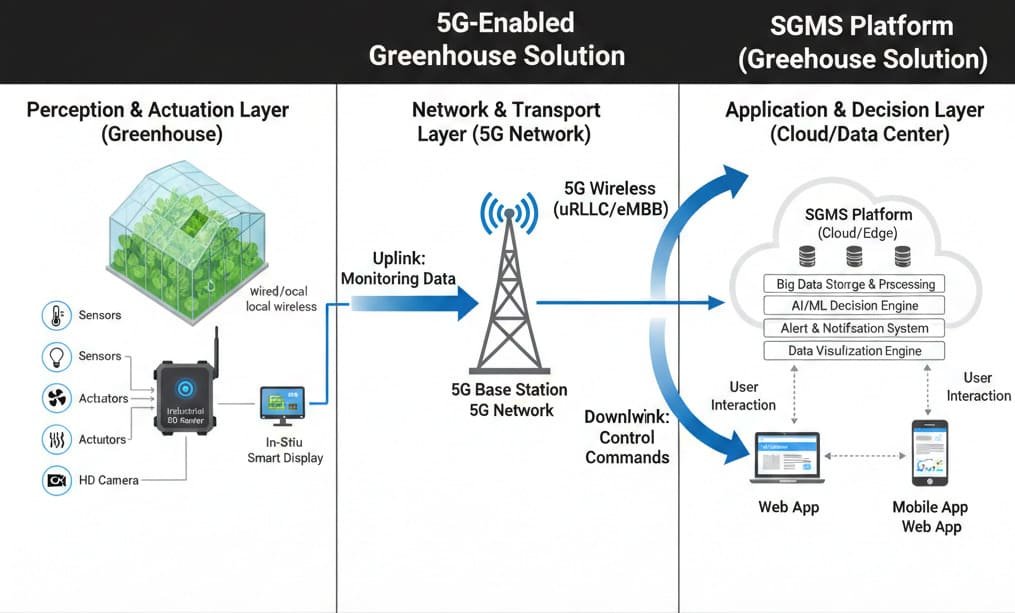
The Smart Greenhouse solution is built upon a layered architecture: the Perception Layer, the Network Layer, and the Application Layer.
3.1. Perception Layer (Data Acquisition)
This layer involves the deployment of various sensors and monitoring devices to capture real – time environmental and biological data within the greenhouse.
Environmental Sensors:
- Climate: Temperature and humidity sensors (air/soil), light intensity (PAR/lux), and CO₂ concentration.
- Soil Health: Soil moisture probes, pH/EC (Electrical Conductivity) sensors, and nutrient level sensors.
- Video Monitoring: High – definition (HD) cameras and thermal imaging cameras for crop growth monitoring, disease detection, and security surveillance.
- Actuators (Control Devices): Automated ventilation fans, retractable shading screens, drip irrigation valves, heating/cooling systems, and precise fertigation pumps.
3.2. Network Layer (Data Transmission)
The Network Layer is the backbone, relying on 5G infrastructure to ensure robust, low – latency, and high – throughput communication.
Industrial 5G Routers R5100: These ruggedized devices serve as the central hub for each greenhouse. They connect all the local sensors and actuators via wired (Ethernet, RS – 485) and wireless (Wi – Fi, Bluetooth) connections and transmit the aggregated data securely to the Cloud Platform using the 5G network.
Key benefits of Industrial 5G Routers: High – speed data uplink, wide operating temperature range (suitable for harsh environments), high reliability, and integrated security features.
5G Base Stations: Provide the wide – area, high – speed wireless coverage required for the massive data streams (especially HD video) and for reliable remote control (low latency).
Local Area Network (LAN): Within the greenhouse, a robust LAN connects the routers to the numerous IoT end devices.
3.3. Application Layer (Data Processing and Control)
This is where data is processed, analyzed, and translated into actionable commands.
Cloud/Edge Computing Platform (Smart Greenhouse Management System – SGMS):
- Data Storage and Analysis: Collects, stores, and processes data from all connected greenhouses in real – time. Utilizes Machine Learning (ML) algorithms to correlate environmental data with optimal crop growth models.
- Decision Support System (DSS): Automatically generates optimal control strategies (e.g., “If air temperature > 30°C and humidity < 40%, open vents 50% and activate misting system for 5 minutes”).
- Alert and Notification System: Instantly notifies the manager via mobile app or display screen of critical anomalies (e.g., sudden power loss, pest outbreak, or sensor failure).
User Interface (UI):
- Smart Display Screens (In – Situ): Large screens inside or near the greenhouse entrance display the most critical, real – time environmental metrics (temp, humidity, water status) for local quick reference.
- Mobile/Web Application (Remote): The primary tool for the farm manager. Allows for remote visualization of all connected greenhouses, manual override of automated controls, historical data viewing, and report generation.
4. Key Solution Features and Advantages
4.1. Enhanced Management Efficiency (One Manager for Multiple Greenhouses)
By automating routine tasks and centralizing data visualization, one skilled manager can effectively supervise dozens of large greenhouses. The system replaces continuous manual checks with automated monitoring and remote corrective actions via the mobile app, significantly reducing labor dependency.
4.2. Precision Resource Management and Cost Reduction
- Water Conservation: Soil moisture sensors trigger the irrigation system only when necessary, and the system delivers the precise volume required based on crop stage and evapotranspiration models. This targeted approach can reduce water consumption by 30% to 50% compared to traditional methods.
- Energy Optimization: Automated shading, ventilation, and heating/cooling systems maintain optimal conditions with minimal energy use, only activating when the environment deviates from the set optimal parameters.
4.3. Real – Time Diagnostics and Disease Prevention
High – definition visual monitoring, coupled with ML – driven analysis of environmental parameters, allows for the early detection of plant stress, pests, and diseases. Low – latency 5G ensures that control commands for precision spraying or ventilation adjustments are executed immediately, halting the spread of issues before they become widespread.
4.4. Improved Crop Yield and Quality
The system ensures that the crops consistently grow under their ideal conditions (optimal light, temperature, humidity, and nutrient levels). This stability and precision directly translate into higher yields and superior quality produce, fetching better market prices.
5. Implementation Process
- Site Assessment and Planning: Evaluate existing infrastructure, identify optimal locations for 5G base stations, and determine sensor/actuator density based on crop type.
- Hardware Installation: Deployment of environmental sensors, actuators (irrigation/ventilation), HD cameras, and the central Industrial 5G Routers in each greenhouse.
- Network Configuration: Establishing the 5G connection, configuring the LAN, and ensuring secure communication between the routers and the Cloud Platform.
- Platform Deployment and Calibration: Deploying the SGMS platform, loading crop – specific growth models, and calibrating the sensor readings and control logic.
- Training and Handover: Comprehensive training for farm managers on using the mobile/web application, interpreting data, and performing system maintenance.
6. Conclusion
The integration of 5G, Industrial IoT, and Cloud Computing represents a paradigm shift for agriculture in resource – sensitive regions. The 5G – Enabled Smart Greenhouse Solution not only guarantees high – quality, stable crop production but also champions environmental stewardship by drastically improving the efficiency of resource use, particularly water. This automated, data – driven approach is essential for modernizing the agricultural sector in Xinjiang and ensuring its long – term sustainable growth.
The “Agriculture Innovation Zone” was established for the first time at COP30, showcasing agricultural technologies addressing climate change, including climate-resilient crops, low-emission livestock systems, and water-saving and solar-powered irrigation. Milah believes this initiative symbolizes a structural shift in agriculture’s role within the global climate governance system: agriculture is no longer marginalized but is now considered a core area for responding to extreme climate events.