
Industrial 4G routers serve as the wireless communication core for EV charging stations, enabling stable, secure, and low-cost remote connectivity between distributed charging piles and cloud management platforms, solving the pain points of scattered deployment, difficult wiring, and high on-site maintenance.
- System Architecture
1.1 Perception Layer (Charging Pile End)
- Core Devices: AC/DC charging piles, metering modules, power control units, and human-machine interaction (HMI) panels.
- Data Collection: Real-time acquisition of charging power, voltage/current, SOC, transaction records, fault codes, and equipment status via RS232/RS485/Ethernet
1.2 Network Layer (Industrial 4G Router)
- Core Equipment: Industrial-grade 4G cellular routers R3000.
- Networking Mode:
- Insert IoT SIM cards to access 4G cellular networks (supports dual-SIM/dual-mode for automatic failover).
- Establish encrypted VPN tunnels (IPSec/WireGuard VPN) or APN private networks for secure data transmission.
- Downlink connects to charging piles via Ethernet/serial ports; uplink accesses the Internet/cloud platform.
1.3 Platform Layer (Cloud Management Center)
- Functions: Real-time monitoring, remote control, data analysis, billing settlement, fault alarm, and OTA upgrades.
- Components: IoT cloud platform, charging operation system, payment gateway, and user APP/WeChat Mini Program.
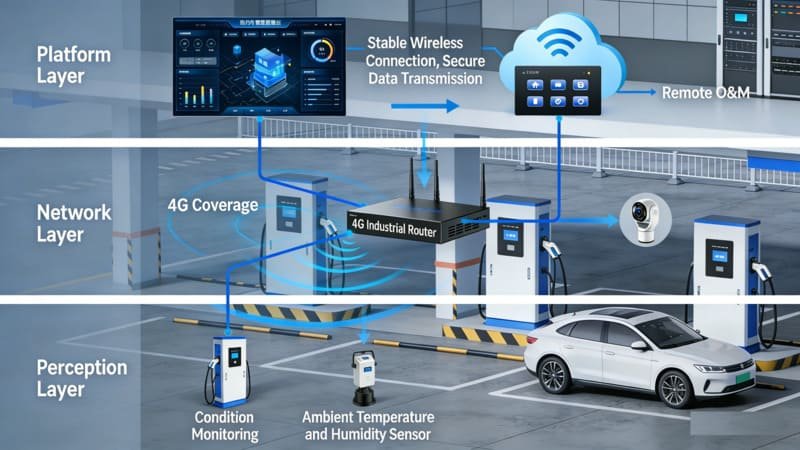
4G Solution for EV Charging Stations
- Core Functions of Industrial 4G Routers
2.1 Stable Wireless Connectivity
- Industrial-grade design: Wide temperature (-40°C to +75°C), wide voltage (9–36V DC), lightning protection, adapting to outdoor harsh environments.
- Dual-SIM redundancy: Automatic switching between carriers (e.g., China Mobile/Unicom/Telecom) to ensure >99.9% online rate.
- Link self-healing: Automatic reconnection upon network disconnection; supports ping detection and watchdog mechanisms.
2.2 Secure Data Transmission
- Encryption protocols: IPSec, L2TP, OpenVPN, WireGuardto prevent data tampering and eavesdropping.
- Firewall & access control: MAC/IP filtering, port forwarding, and client isolation to block unauthorized access.
- Data integrity: Supports TLS 1.3 and AES-256 encryption for transaction and billing data.
2.3 Remote Management & O&M
- Remote configuration: One-click parameter setting, network diagnosis, and status query via cloud platform.
- FOTA upgrade: Batch firmware/software updates for charging piles and routers without on-site visits.
- Fault diagnosis: Real-time alarm for offline, communication failure, voltage abnormality, etc., with SMS/email/APP notifications.
2.4 Data Collection & Forwarding
- Protocol adaptation: Supports Modbus RTU/TCP, MQTT, HTTP/HTTPS, and charging pile private protocols.
- Edge computing: Local data caching and preprocessing to reduce cloud pressure and ensure transmission reliability.
- Bidirectional communication: Uploads pile status/charging data; receives cloud control commands (start/stop charging, price adjustment).
2.5 Payment & User Interaction Support
- NFC/Wi-Fi hotspot: Enables mobile payment, APP reservation, and QR code scanning via built-in Wi-Fi/NFC.
- Low-latency transmission: QoS optimization ensures millisecond-level response for payment and control commands.
- Typical Application Scenarios
3.1 Urban Public Charging Stations
- Pain point: Scattered locations, no wired broadband, high wiring cost.
- Solution: Deploy industrial 4G routers at each pile; connect to the operator’s cloud platform via 4G; realize unified monitoring, billing, and remote O&M.
- Benefits: Reduce construction cost by ~30%; cut O&M cost by >40% via remote management.
3.2 Highway/Remote Area Fast Charging
- Pain point: No fiber coverage, weak signal, unattended operation.
- Solution: Use dual-SIM industrial routers with high-gain antennas; support APN private network; ensure stable connection in weak-signal areas.
- Case: European Ionity highway fast-charging network uses industrial 4G routers to connect off-grid solar charging stations to the cloud.
3.3 Residential/Community Charging Piles
- Pain point: Difficult to lay cables, need user self-service payment.
- Solution: 4G router + Wi-Fi hotspot; supports APP/WeChat payment and reservation; remote fault detection and firmware upgrade.
3.4 Fleet Charging (Logistics/Ride-Hailing)
- Pain point: Centralized management of multiple piles; real-time load control and dynamic pricing.
- Solution: Routers upload real-time power data; cloud platform implements load balancing and dynamic pricing based on grid conditions.
- Advantages of the Solution
- Low deployment cost: No fiber/cable laying; plug-and-play; suitable for rapid large-scale rollout.
- High reliability: Industrial design + dual-SIM + self-healing; adapts to harsh outdoor environments.
- Secure and compliant: Encrypted transmission + firewall + access control; meets payment and data security regulations.
- Intelligent O&M: Remote management + FOTA + fault alarm; reduces on-site maintenance by >70%.
- Strong scalability: Supports 5G evolution; easy to add new piles and expand functions.
- Typical Hardware & Software Configuration
5.1 Recommended Industrial 4G Router Models
- R3000: Compact, dual-SIM, VPN, Wi-Fi; suitable for integrated charging piles.
5.2 Software Platform
- Charging management system: Real-time monitoring, billing, user management, data analysis.
- Router cloud management: Remote configuration, upgrade, fault diagnosis, traffic statistics.
- Payment gateway: Integrates Alipay/WeChat/UnionPay/NFC for secure transactions.
Industrial 4G routers are the key enabler for intelligent and networked EV charging stations. They solve the core problems of decentralized deployment, difficult wiring, and high maintenance costs, and provide a stable, secure, and cost-effective wireless communication solution for the large-scale construction and operation of charging infrastructure. With the popularization of 5G, this solution can be smoothly upgraded to 5G for higher bandwidth and lower latency, supporting more intelligent charging services such as V2G and smart grid interaction.