
While both Coordinated Multi-Point (CoMP) and Cell-Free Massive MIMO use multiple transmission points to improve network performance and reduce interference, they represent fundamentally different architectural philosophies.
CoMP is a patch/extension added to traditional cellular networks, whereas Cell-Free Massive MIMO is a ground-up redesign that completely removes cell boundaries.
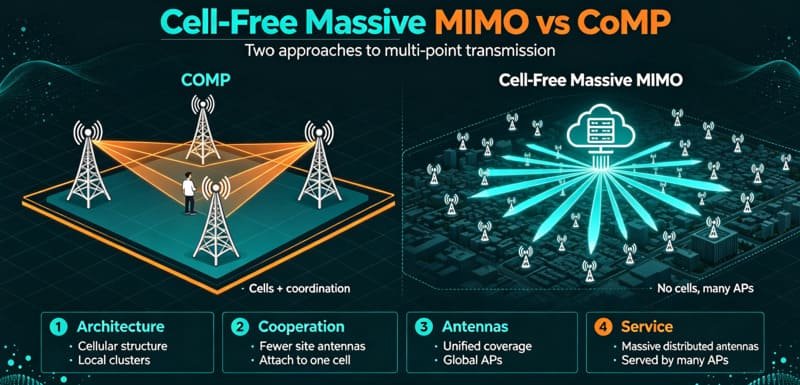
Feature | Coordinated Multi-Point (CoMP) | Cell-Free Massive MIMO |
Primary Design Goal | Improve performance specifically at cell boundaries | Provide uniform high-speed connectivity across the entire coverage area |
Network Geometry | Cell-Centric: Network remains divided into fixed cells; adjacent base stations coordinate conditionally | User-Centric: No cells exist; fluid clusters of distributed Access Points (APs) follow the user |
Scalability | Limited coordination across a few neighboring base stations/sectors due to high signaling overhead | Scalable across hundreds of low-power APs via localized user-centric clustering |
Antenna Topology | Few high-power, co-located antenna arrays mounted on centralized macro towers | Massive number of distributed, low-power single/multi-antenna APs dispersed densely |
Signal Processing | Coordination primarily happens between macro eNBs/gNBs (often at cell edges only) | Scalable distributed processing managed by Central Processing Units (CPUs) |
The following are their specific differences in several key dimensions.
🎯 Service Model: Edge Optimization vs. Global Uniformity
This is the most fundamental difference between the two and determines their design goals and implementation complexity.
CoMP: Born in 4G LTE-Advanced, its original purpose was to solve the inherent “cell-edge” problem of cellular networks. Therefore, it only enables cooperation for specific users located at the cell edge and suffering severe interference. This is a “triggered” remedial measure; most of the time, the network still operates in traditional cellular mode.
CF-mMIMO: Its vision is to eliminate the cell edge itself. It enables all users to obtain almost consistently high-quality service at any location. Every user in the network is served by a dynamic, user-centric AP cluster around them, completely breaking fixed cell boundaries.
🏗️ Network Architecture and Processing: Centralized Cooperation vs. Distributed Joint Processing
Architectural differences determine the signal processing approach and system scalability.
CoMP: Its cooperation usually occurs between geographically separated, fully functional base stations (BSs). This requires exchanging a large amount of channel state information (CSI) and user data between base stations over backhaul links, resulting in huge signaling overhead. To facilitate coordination, it is often combined with a C-RAN architecture to centralize baseband processing.
CF-mMIMO: Architecturally, it consists of a large number of structurally simple APs and a central processing unit (CPU). The APs handle signal transmission and reception, while complex joint processing (such as channel estimation and precoding) is performed at the CPU or through distributed algorithms. Its design goal is scalability: system capacity can continue to increase with the number of APs, while the complexity of individual nodes does not increase accordingly.
📶 Interference Management: Suppression vs. Exploitation
The two have completely different approaches to interference.
CoMP: Its main goal is to suppress or coordinate interference. Its technical means include Joint Transmission (JT), in which multiple base stations simultaneously send the same signal to one user to enhance the desired signal, and Coordinated Scheduling/Beamforming (CS/CB), which avoids mutual interference among users by coordinating scheduling and beam directions.
CF-mMIMO: It does not “suppress” interference; rather, it converts what is traditionally regarded as interference into useful signal energy. Because a large number of APs are spatially dispersed, their signals coherently combine at the target user, enhancing the desired signal; at non-target users, they non-coherently combine, appearing as noise-like interference. This “favorable propagation” characteristic is the fundamental source of its performance gain.
📊 Performance Characteristics: Local Improvement vs. Uniform Coverage
CoMP: Its performance gain is mainly reflected in the throughput improvement of cell-edge users. Some studies indicate that the gain can reach about 30%. However, in terms of overall system spectral efficiency, the improvement is relatively limited.
CF-mMIMO: Its core advantage lies in uniform performance across the coverage area. It can provide higher macro diversity gain, effectively combat shadow fading, and ensure that users obtain stable, high-quality service regardless of where they are. Its potential in system capacity and spectral efficiency far exceeds that of traditional cellular architectures.
⚖️ Key Challenges and Tradeoffs
CoMP: The main challenges lie in complex signaling interactions and the new “cluster edge” problem caused by fixed cooperation clusters. In addition, the assumption of ideal backhaul can severely limit its performance gain under actual non-ideal backhaul conditions.
CF-mMIMO: The challenges lie in scalability and implementation complexity. Dynamically forming serving clusters for all users, jointly processing signals from massive APs, and managing pilot contamination are all extremely complex problems. How to reduce computation and fronthaul/backhaul overhead while maintaining performance is key to its practical deployment.