
1 Introduction
The integration of Industrial 5G routers into unmanned forklift clusters represents a transformative advancement in industrial automation and smart logistics. By providing high-reliability, low-latency communication, 5G technology effectively overcomes the limitations of traditional wireless solutions like Wi-Fi, which often suffers from instability, coverage gaps, and security vulnerabilities. In automated environments such as smart factories and warehouses, 5G-enabled unmanned forklifts—including Automated Guided Vehicles (AGVs) and smart forklifts—have become crucial for tasks like raw material transport, pallet handling, and inventory management. This article explores the application of industrial 5G routers in unmanned forklift clusters, highlighting technical architectures, key benefits, and real-world implementations.
2 System Architecture and Working Principle
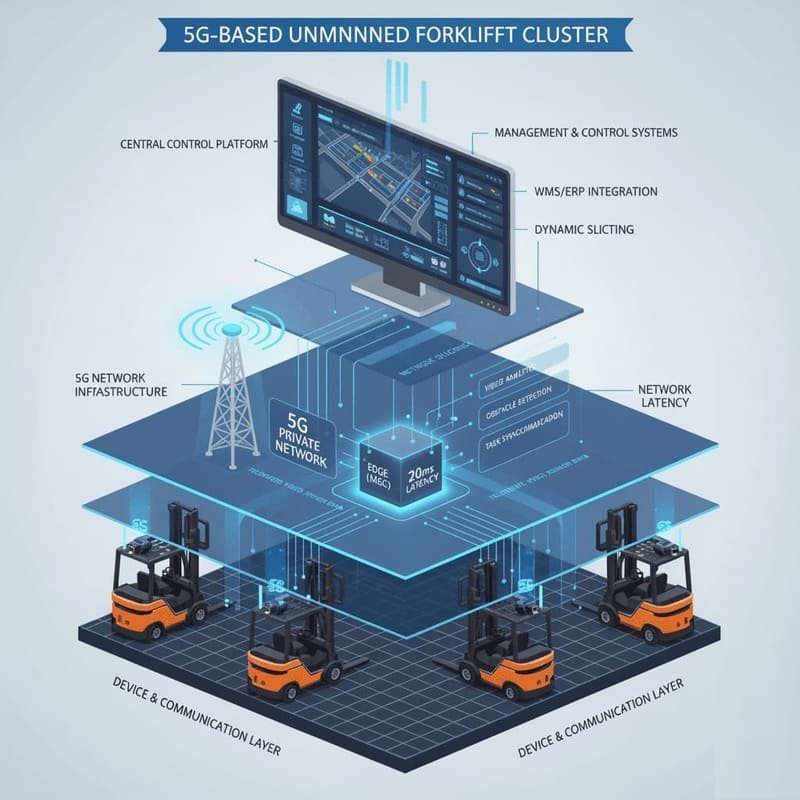
The deployment of 5G-based unmanned forklift clusters relies on a layered architecture that ensures seamless coordination between vehicles, control systems, and enterprise platforms.
5G Network Infrastructure: A dedicated 5G private network forms the backbone, often using a simplified “one 5G network + one edge cloud” architecture. This setup provides comprehensive factory coverage with end-to-end latency as low as 20 milliseconds, which is critical for real-time control. Core network elements are deployed on-site or near the premises (e.g., in a local center), creating an isolated, secure data environment.
Edge Computing Integration: Multi-access Edge Computing (MEC) plays a vital role by processing data locally. For instance, video feeds from forklifts are analyzed at the edge for obstacle detection and route optimization, reducing response times and core network load. MEC also hosts algorithms that synchronize forklift tasks with production orders and inventory data.
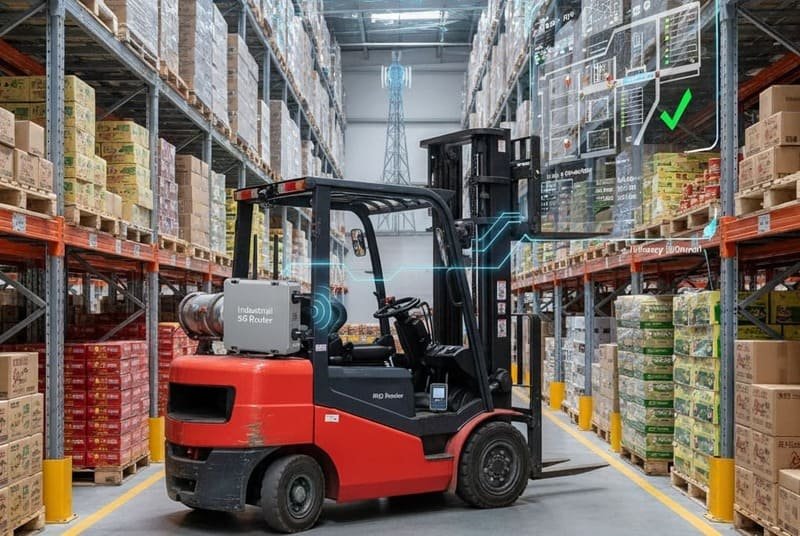
Device and Communication Layer: Unmanned forklifts are equipped with 5G industrial routers or gateways that enable them to transmit telemetry, video, and sensor data in real-time. These routers support network slicing, ensuring prioritized bandwidth for critical control commands. Additionally, technologies like RFID and laser SLAM enhance positioning accuracy to within ±3 cm.
Management and Control Systems: Forklift operations are managed through a central control platform (e.g., integrated with Warehouse Management Systems/WMS or Enterprise Resource Planning/ERP). This platform monitors forklift status, assigns tasks, and dynamically re-routes vehicles based on real-time factory conditions.
*Table: Key Components of a 5G-Based Unmanned Forklift System*
Component | Function | Example |
5G Private Network | Provides secure, low-latency connectivity for forklifts and factory devices | Local 5G base stations and core network deployed on-premise |
Industrial 5G Router | Enables wireless communication for forklifts via 5G networks | 5G Industrial Router |
MEC Platform | Processes data locally for real-time decision-making | Video analytics for obstacle avoidance and path optimization |
AGV/Forklift Control System | Monitors and schedules tasks for the unmanned forklift cluster | Integration with WMS/ERP for automated material handling |
3 Advantages of 5G Routers in Unmanned Forklift Applications
3.1 Ultra-Reliable Low-Latency Communication
5G networks offer millisecond-level latency (under 20 ms), which is indispensable for real-time control of unmanned forklifts. This enables instantaneous response to instructions, emergency stops, and dynamic path adjustments. In contrast, Wi-Fi networks often experience interference and handover delays, leading to AGV stalling or collisions.
3.2 Enhanced Mobility and Flexibility
Industrial 5G routers support seamless roaming across large factory floors. Forklifts can maintain stable connections without interruptions, even when moving between different coverage zones. For example, in a tire manufacturing plant, 5G-enabled AGVs achieved continuous operation across workshops, eliminating WiFi-related drop-offs.
3.3 Improved Positioning and Navigation Accuracy
With 5G, unmanned forklifts leverage navigation technologies (laser SLAM, vision, etc.) to achieve precise positioning. In one case, AGV positioning accuracy reached ≤±3 cm, allowing them to navigate narrow aisles and adapt to dynamic obstacles within 100 ms.
3.4 Scalability and Network Slicing
5G network slicing allows operators to create virtual dedicated networks for different services. For instance, one slice can be allocated for forklift control, while another supports video surveillance. This ensures that critical applications never compete for bandwidth.
3.5 Energy Efficiency and Cost Savings
5G-enabled energy management modules can monitor and optimize the power consumption of forklifts. By analyzing operational data, the system automatically shuts down idle vehicles or adjusts their routes, reducing energy usage by up to 15%.
4 Application Scenarios
Raw Material Handling: In the engine manufacturing process at Foton Cummins, 5G-powered unmanned forklifts automatically transport cylinder heads from warehouses to assembly lines, synchronizing with production schedules.
High-Density Warehousing: In a seasoning company’s storage facility, 5G smart forklifts communicate with the WMS to execute picking and placing orders. The routers ensure stable data flow between forklifts and the central system, improving inventory accuracy.
Multi-Vehicle Coordination: Some scenarios require multiple forklifts to collaboratively handle oversized items. For example, two AGVs can combine forces via 5G coordination to carry loads of up to 4 tons.
5 Case Study: 5G Smart Forklifts at Donggu Seasoning Company
At Guangdong-based Donggu Seasoning Food Co., Ltd., traditional forklift operations relied on manual searching and paper-based verification, leading to low efficiency and high labor costs. The company partnered with a telecom operator to deploy a 5G private network + smart forklift system.
Each forklift was fitted with a 5G industrial router and an RFID reader. The routers established a secure, low-latency link (under 20 ms) to the warehouse management system. When an order is received, the forklift automatically identifies the goods’ location, retrieves them, and confirms delivery via digital checkout. This system has improved warehouse flow efficiency and reduced manual errors.
6 Conclusion
Industrial 5G routers have become the nervous system of unmanned forklift clusters, offering a robust foundation for automation in smart factories and warehouses. Through high-bandwidth, low-latency, and secure connectivity, they empower forklifts to operate with unprecedented efficiency, accuracy, and intelligence. As 5G technology evolves with edge computing and AI, the integration of 5G routers in material handling will further drive the transformation toward flexible, efficient, and sustainable industrial operations.